We earn a commission if you buy through links on this page, at no extra cost to you.
A far infrared sauna uses carbon or ceramic panels that give off mostly far infrared. A full spectrum sauna adds near and mid infrared emitters, usually lamps, glass heating tubes or an LED panel, alongside those panels. Full spectrum cabins cost more and some need a bigger electrical circuit. Buy far infrared if you want a proven, simpler cabin for sweating and relaxing. Buy full spectrum if you specifically want near infrared or red light and you’re happy to pay for it.
Our quick picks
- Far infrared: Dynamic Saunas Andora. 6 carbon panels, 135°F, standard 15 amp plug.
- Full spectrum: Dynamic Saunas Cordoba. Near, mid and far infrared, 140°F, standard 15 amp plug.
- Most heat: JNH Joyous+ 2-Person. Far infrared up to 170°F with 8 carbon heaters.
How we compared: we haven’t tested these saunas hands-on. The infrared bands below follow the standard CIE definitions; product details are each seller’s claims from the current Amazon listing; health claims from listings are left out unless they’re backed by research. How we review.
Last updated 15 October 2026. Specs and availability from each Amazon listing, checked that day.
Full spectrum vs far infrared at a glance
| Far infrared | Full spectrum | |
|---|---|---|
| Infrared bands | Mostly far | Near, mid and far |
| Heaters | Carbon or ceramic panels | Panels plus lamps, glass tubes or LED panel |
| Typical max heat | 135°F to 140°F (170°F on some) | 140°F to 149°F |
| Power | Usually a standard 15 amp outlet | 15 amp on some, dedicated 20 amp on others |
| Price | Lower | Higher for the same size |
From the Amazon listings of the saunas in this guide. Price comparison: Dynamic’s full spectrum Cordoba lists for more than its far infrared Andora on Amazon.
What near, mid and far infrared mean
Infrared is the part of the light spectrum just past visible red. The CIE, the international body that sets lighting standards, splits it into three bands by wavelength: near infrared (IR-A) from 700 to 1,400 nanometers, mid infrared (IR-B) from 1,400 to 3,000 nanometers, and far infrared (IR-C) from 3,000 nanometers up. Other standards draw the lines in different places, which is one reason sauna marketing uses these terms loosely.
Carbon and ceramic panels run warm, not glowing hot, and give off mainly far infrared, which you feel as gentle radiant heat. Near infrared comes from hotter sources such as halogen-style lamps and glass heating tubes, or from LED panels. The “red light therapy” panels in some saunas are LEDs at 660 nanometers (visible red) and 850 nanometers (near infrared).
What the research does and doesn’t say
Most long-term research on regular sauna use comes from Finland and looks at traditional hot-air saunas, not infrared cabins. Research on infrared saunas specifically is smaller, and research on near infrared and red light is mostly separate from saunas, using dedicated devices at measured doses. So a full spectrum sauna isn’t proven to do more for your health than a far infrared one. Treat claims about detox, skin or weight loss on sauna listings as marketing. What you can count on from either type is heat, sweat and relaxation. Our far infrared sauna guide covers the far infrared side in more detail.
Practical differences that matter
Heat
Full spectrum cabins don’t necessarily get hotter. The Cordoba lists 140°F, the same as many far infrared cabins, and the SunSwell lists up to 149°F. If heat is what you’re after, the far infrared JNH Joyous+ goes furthest at up to 170°F.
Power
The extra emitters draw more power, and some full spectrum cabins need a dedicated 20 amp circuit. The Dynamic Cordoba (1750 watts) and springspa 1-2 Person (1690 watts) run on a standard 15 amp outlet; springspa’s 2 Person (1890 watts) and the DAIMOT 2-Person (1990 watts) need a dedicated 20 amp outlet, per their listings. Check this before you order.
Light and eyes
Near infrared lamps and red light panels are bright. Don’t stare into them, and follow the manual: one full spectrum brand, CedarLuma, includes protective goggles to wear while its red light panel is on.
Price
For the same size and brand, full spectrum costs more. If you’re on a budget, a far infrared cabin gets you the same sweat for less.
Far infrared picks
Dynamic Saunas Andora 2-Person
6 carbon panels, up to 135°F (115°F to 130°F recommended), 43 x 37 x 68 inches inside, a standard 15 amp plug and a 5-year limited warranty on electronics. See it with others in the best 2 person infrared saunas.

JNH Lifestyles Joyous+ 2-Person
8 carbon fiber heaters, up to 170°F, and an average EMF reading under 8 mG from third-party tests, per JNH. See Joyous vs Joyous+.

Full spectrum picks
Dynamic Saunas Cordoba: best full spectrum
Near, mid and far infrared in a Canadian hemlock cabin, 42 x 36 x 68 inches inside, up to 140°F with 120°F to 130°F recommended. It draws 1750 watts on a standard 15 amp, 120 volt plug, assembles in about an hour and carries Dynamic’s 5-year limited warranty.

SunSwell 2 Person Full Spectrum: compact
At 40.16 x 35.43 x 67 inches it fits small spaces. Its listing describes three mica heating panels and three red-light glass heating tubes, up to 1,476 watts, a range of 64°F to 149°F, a 1 to 99 minute auto shut-off timer, and click-lock assembly without tools. SunSwell recommends keeping sessions to 40 minutes or less.

springspa 1-2 Person Full Spectrum: red light panel
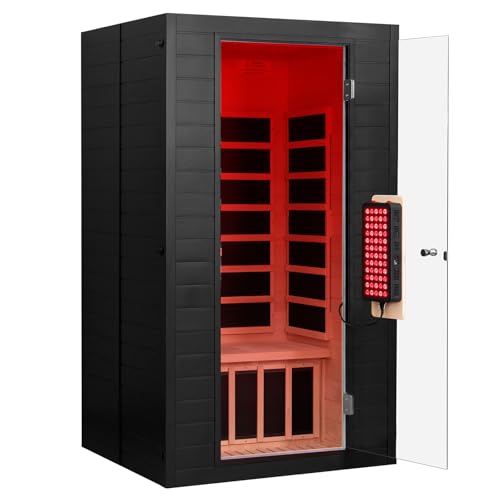
This one pairs 850 nanometer near infrared heating with a 660 nanometer red light, per its listing. It’s 43.5 x 37.4 x 74.8 inches, hemlock, with 6 heating panels at 1690 watts on a 15 amp outlet, 77°F to 149°F, and 15 to 25 minutes to heat up.
Which should you buy?
- Far infrared if you want a straightforward cabin for heat and relaxation, a lower price, and a standard outlet.
- Full spectrum if you specifically want near infrared or red light in the same cabin and you’ve checked your circuit.
- Either way, pick the size first, then check the power, warranty and wood. See the best wood for an infrared sauna and the best home sauna brands.
Before your first session, read how to use a sauna safely.
Frequently asked questions
What is the difference between full spectrum and far infrared saunas?
A far infrared sauna uses carbon or ceramic panels that give off mainly far infrared. A full spectrum sauna adds near and mid infrared emitters, such as lamps, glass heating tubes or an LED panel, alongside the panels.
Is a full spectrum sauna better than far infrared?
Not proven. Most long-term sauna research is on traditional saunas, and near infrared research mostly uses separate devices. A full spectrum sauna costs more and may need a bigger circuit; buy it if you specifically want near infrared.
Does a full spectrum sauna get hotter?
Not necessarily. The full spectrum Dynamic Cordoba lists 140°F, like many far infrared cabins. The hottest cabin we cover is the far infrared JNH Joyous+ 2-Person, at up to 170°F.
Do full spectrum saunas need a 20 amp circuit?
Some do. The Dynamic Cordoba and springspa 1-2 Person run on a standard 15 amp outlet, while springspa’s 2 Person and the DAIMOT 2-Person need a dedicated 20 amp outlet, per their listings.
What wavelengths are near, mid and far infrared?
By the CIE definitions, near infrared runs from 700 to 1,400 nanometers, mid infrared from 1,400 to 3,000 nanometers, and far infrared from 3,000 nanometers up.
Sources: the Amazon listings for each sauna named, checked 15 October 2026; JNH Lifestyles’ Joyous+ specification page; CIE infrared bands as cited in Vatansever and Hamblin, “Far infrared radiation (FIR): its biological effects and medical applications”.